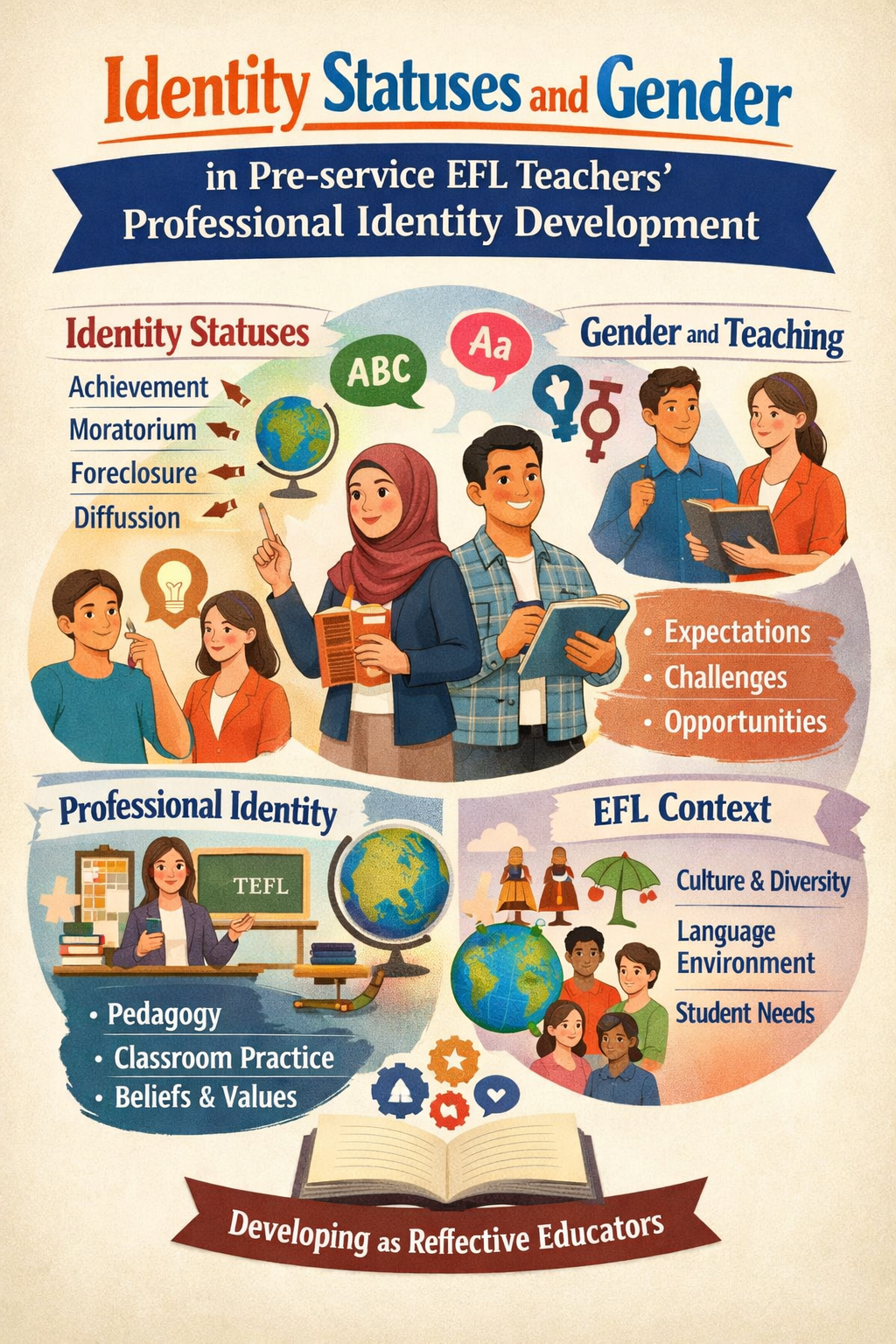
Identity Statuses and Gender in Pre-service EFL Teachers’ Professional Identity Development
Keywords:
Gender, Identity statuses, Pre-service teachers, Teacher Professional Identity, Language teacher educationAbstract
The professional identity construction of pre-service English-as-a-Foreign-Language (EFL) teachers (PSETs) has been the subject of considerable scholarly attention. Nonetheless, the specific roles of gender, identity statuses, and their interaction remain insufficiently investigated. This study seeks to examine the extent to which gender, identity statuses, and the interaction between these variables influence the professional identity construction of PSETs. A total of ninety PSETs (N = 90) enrolled in a teacher education program in Indonesia served as the sample of the study. Data were collected through questionnaires and analyzed using a two-way ANOVA to determine the influence of gender, identity statuses, and their interaction on professional identity development. Findings revealed that identity statuses exerted a significant influence on professional identity formation, with pronounced differences identified between participants in the Identity Diffusion and Identity Achievement categories. By contrast, gender and the interaction between gender and identity statuses were not found to indicate significant influence. These results call into question prevailing assumptions regarding the influence of gender on professional identity construction, highlighting instead the centrality of identity exploration and commitment.
References
Asayesh, M. H., & Vakili, M. (2020). Self-efficacy and identity statuses in students of Iran. Global Journal of Guidance and Counseling in Schools: Current Perspectives, 10(3), 102–109. https://doi.org/10.18844/gjgc.v10i3.4760
Banegas, D. L. (2022). Four spheres of student-teachers’ professional identity formation through learning about curriculum development. Journal of Education for Teaching, 49(3), 370–383. https://doi.org/10.1080/02607476.2022.2105644
Barbosa, S. M. A. D. (2017). Language teacher education: Identities under construction. European Journal of Multidisciplinary Studies, 6(1), 161–171. https://doi.org/10.26417/ejms.v6i1.p161-171
Beijaard, D., Meijer, P. C., & Verloop, N. (2004). Reconsidering research on teachers’ professional identity. Teaching and Teacher Education, 20(2), 107–128. https://doi.org/10.1016/j.tate.2003.07.001
Borg, S. (2019). Language teacher cognition: Perspectives and debates. In X. Gao (Ed.), Second handbook of English language teaching (pp. 1149–1170). Springer. https://doi.org/10.1007/978-3-319-58542-0_59-2
Cheng, L. (2021). The implications of EFL/ESL teachers’ emotions in their professional identity development. Frontiers in Psychology, 12(September), 1–7. https://doi.org/10.3389/fpsyg.2021.755592
Cohen, L., Manion, L., & Morrison, K. (2007). Research methods in education (6th ed.). Routledge.
Crowe, F., & McGarr, O. (2022). “Foreclosing” a teaching career? An exploration of the career decisions of undergraduate pre-service teachers through the lens of Identity Status Theory. Teaching and Teacher Education, 115, 103744. https://doi.org/10.1016/j.tate.2022.103744
Dilek, E., & Altas, B. (2022). The relationship between EFL teachers’ professional identity and professional autonomy. Asian Journal of Education and Training, 8(1), 22–33. https://doi.org/10.20448/edu.v8i1.3806
Friesen, M. D., & Besley, S. C. (2013). Teacher identity development in the first year of teacher education: A developmental and social psychological perspective. Teaching and Teacher Education, 36, 23–32. https://doi.org/10.1016/J.TATE.2013.06.005
Gnatyshina, E. A., Uvarina, N. V., Salamatov, A. A., Savchenkov, A. V., & Pakhtusova, N. A. (2018). Analysis of gender differences in the professional identity indicators of pedagogical university students. Espacios, 39(29).
Gracia, E. P., Rodríguez, R. S., & Pedrajas, A. P. (2022). Teachers’ professional identity construction: A review of the literature. Profesorado, 26(1), 371–393. https://doi.org/10.30827/profesorado.v26i1.13211
Imelwaty, S., Abrit, R., & Kemal, E. (2022). The construction of pre-service English language teachers’ identity: Attitudes toward Indonesian English. Langkawi: Journal of The Association for Arabic and English, 8(2), 178–187. https://doi.org/10.31332/lkw.v0i0.5294
Kaya, M. D., & Çok, F. (2021). From Marcia to the present: A review in the context of status and process models. Cyprus Turkish Journal of Psychiatry and Psychology, 3(2), 144–152. https://doi.org/10.35365/ctjpp.21.2.16
Kaymakamoğlu, S. E. (2019). In search of developing practical knowledge in pre-service EFL teachers: A proposed model. Journal of Language and Linguistic Studies, 15(3), 1000–1010. www.jlls.org
Kroger, J., & Marcia, J. E. (2011). The identity statuses: Origins, meanings, and interpretations. In S. J. Schwartz, K. Luyckx, & V. L. Vignoles (Eds.), Handbook of identity theory and research (pp. 31–53). Springer. https://doi.org/10.1007/978-1-4419-7988-9
Lile, J. (2013). Toward a structural understanding of identity formation: A review and extension of theory. Identity, 13(4), 318–347. https://doi.org/10.1080/15283488.2013.780974
Macías Villegas, D. F., Hernández Varona, W., & Sánchez Gutiérrez, A. (2020). Student teachers’ identity construction: A socially-constructed narrative in a second language teacher education program. Teaching and Teacher Education, 91, 1–10. https://doi.org/10.1016/j.tate.2020.103055
Marcia, J. E. (1966). Development and validation of ego identity status. Journal of Personality and Social Psychology, 3(5), 551–558.
Marcia, J. E. (1980). Identity in Adolescence. Handbook of Adolescence Psychology. https://doi.org/10.4324/9780203346860
Marcia, J. E. (2006). Ego identity and personality disorders. Journal of Personality Disorders, 20(6), 577–596. https://doi.org/10.1521/pedi.2006.20.6.577
Martinussen, M., & Kroger, J. (2013). Meta-analytic studies of identity status and personality: Introduction and overview. Identity, 13(3), 189–200. https://doi.org/10.1080/15283488.2013.799474
Nickel, J., & Zimmer, J. (2019). Professional identity in graduating teacher candidates. Teaching Education, 30(2), 145–159. https://doi.org/10.1080/10476210.2018.1454898
Ningrum, A. S. B., Yatin, A., Aini, N., Orwela, C., & Hajan, B. H. (2024). Beyond gender: How personality types affect pre-service EFL teachers’ speaking skills. Journal of Languages and Language Teaching, 12(2), Article 907. https://doi.org/10.33394/jollt.v12i2.10885
Pérez-Gracia, E., Serrano-Rodríguez, R., & Pontes-Pedrajas, A. (2022). Building EFL preservice teachers’ professional identity: Does gender matter? Profile: Issues in Teachers’ Professional Development, 24(2), 117–131. https://doi.org/10.15446/profile.v24n2.95186
Qin, X., & Liu, S. (2023). The relationship between principal support, teacher professional identity, and teacher professional learning in China: Investigating gender differences. Psychology in the Schools, 60(12), 4871–4884. https://doi.org/10.1002/pits.23066
Ruohotie-Lyhty, M., & Pitkänen-Huhta, A. (2022). Status versus nature of work: Pre-service language teachers envisioning their future profession. European Journal of Teacher Education, 45(2), 193–212. https://doi.org/10.1080/02619768.2020.1788535
Sachs, J. (2005). Teacher education and the development of professional identity: Learning to be a teacher. In M. Kompf & P. Denicolo (Eds.), Connecting policy and practice (1st ed., pp. 5–21). Routledge.
Salinas, D., & Pizarro, J. (2023). Pre-service EFL teachers' identity formation: A longitudinal study through e-portfolio. Journal for Research Scholars and Professionals of English Language Teaching, 7(40).
Sarie, R. F., Pratolo, B. W., & Purwanti, E. (2020). Identity Formation: An auto-ethnography of Indonesian student becomes a legitimate speaker and teacher of English. International Journal of Evaluation and Research in Education, 9(3), 691-696. http://doi.org/10.11591/ijere.v9i3.20399
Shand, J. (2023). Professional voices: Building professional teacher identity in an initial teacher education programme. Australian Journal of Teacher Education, 48(7), 1–16. https://doi.org/10.14221/1835-517X.5881
Shodiq, S. F., & Syamsudin, S. (2019). Teacher identity reconstruction: Socio-anthropological study of Javanese society. Cakrawala Pendidikan, 38(3), 477-489. https://doi.org/10.21831/cp.v38i3.26098
Soylu, Y., Siyez, D. M., & Özeren, E. (2021). Gender perception, career optimism, and career adaptability among university students: The mediating role of personal growth initiative. International Journal of Progressive Education, 17(1), 1–15. https://doi.org/10.29329/ijpe.2021.329.1
Tambak, S., Sukenti, D., Husti, I., Zamsiswaya, Z., & Mahfud, C. (2023). Teacher identity, Islamic behavior, and project-based learning methods for madrasah teachers: A phenomenological approach. International Journal of Islamic Educational Psychology, 4(1), 102–121. https://doi.org/10.18196/ijiep.v4i1.17396
Taşdemir, H., & Seferoğlu, G. (2022). Understanding teacher professional identity: Voices from pre-service English language teachers. Bartın Üniversitesi Eğitim Fakültesi Dergisi, 11(3), 702–717. https://doi.org/10.14686/buefad.1112591
Tran, Y., & Dee, A. (2023). The complexity of teacher identity: Perceptions of pre-service teachers. Journal of Education and Learning, 12(3), 40–53. https://doi.org/10.5539/jel.v12n3p40
Wang, X. Q., Zhu, J. C., Liu, L., Chen, X. Y., & Huo, J. Y. (2018). Active construction of profession-related events: The priming effect among pre-service teachers with different professional identity. Frontiers in Psychology, 9, Article 233. https://doi.org/10.3389/fpsyg.2018.00233
Wong, C. Y. E., & Liu, W. C. (2022). Evaluating the teacher professional identity of student teachers: Development and validation of the teacher professional identity scale. Journal of Education, 2022, 1–16. https://doi.org/10.1177/00220574221101375
Zhao, H., & Zhang, X. (2017). The influence of field teaching practice on pre-service teachers’ professional identity: A mixed methods study. Frontiers in Psychology, 8, Article 1264. https://doi.org/10.3389/fpsyg.2017.01264
Downloads
Published
How to Cite
Conference Proceedings Volume
Section
License
Copyright (c) 2025 Ika Wahyuni Lestari

This work is licensed under a Creative Commons Attribution-ShareAlike 4.0 International License.