Multidisciplinary Evaluation of the Impact of Sand and Stone Mining on Water Quality and the Kampar River Ecosystem
Keywords:
Sand and stone mining, Water quality, River ecosystem, Multidisciplinary impacts, Kampar RiverAbstract
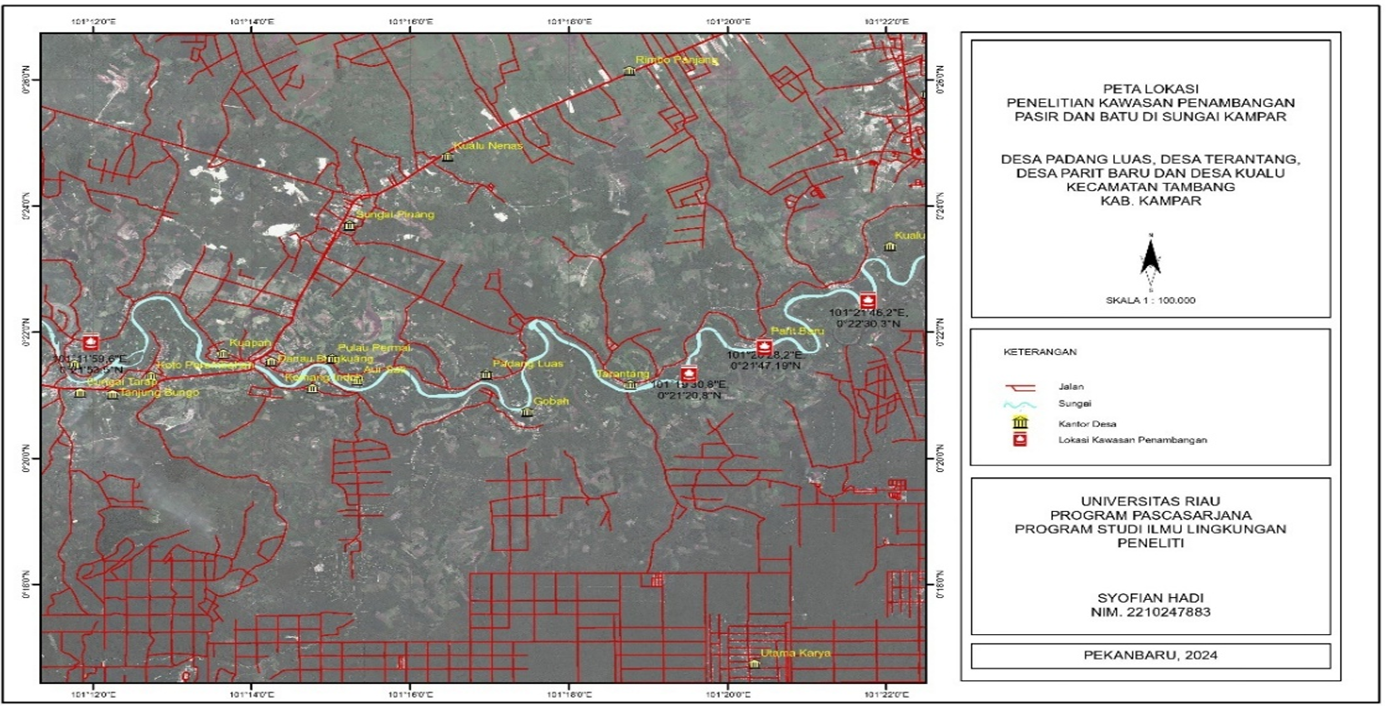
The Kampar River serves as a vital, important freshwater system that sustains ecological processes and provides essential resources for surrounding communities. However, intensive sand and stone mining activities have created increasing pressures on this ecosystem, raising concerns about long-term sustainability. Although mining generates substantial economic returns, its adverse impacts extend beyond ecological degradation, encompassing hydromorphological alterations, reduced biodiversity, and social conflicts. This study employs a multidisciplinary framework to evaluate the impacts of riverbed mining on water quality and ecosystem health, integrating ecological, socioeconomic, and institutional dimensions. Field research was conducted between May and August 2024 across four villages in Tambang District, Kampar Regency, combining water quality monitoring, field observations, and community interviews with secondary datasets such as satellite imagery and official reports. Analytical techniques included physicochemical testing, descriptive assessments, and SWOT analysis to formulate management strategies. The findings indicate a significant decline in water quality, with recorded temperatures of 30.6–34°C, acidic pH levels around 5.2–5.6, and turbidity slightly above national Class II standards. These changes, coupled with continuous dredging, accelerate riverbed deepening, increase the risk of bank collapse, and contribute to declining fish populations and catches. Socially, uncontrolled extraction generates community tensions and heightens socioeconomic disparities, threatening local resilience. SWOT analysis emphasizes strategies such as strengthening regulations, fostering cross-sectoral collaboration, and empowering community-based stewardship. This research provides a comprehensive evidence base to inform sustainable watershed governance, supporting evidence-based and locally grounded decision-making, ensuring ecological integrity, social well-being, and economic development are effectively balanced in managing the Kampar River.
References
American Public Health Association. (2017). Standard methods for the examination of water and wastewater (23rd ed.). American Public Health Association. https://doi.org/10.2105/SMWW.2882
Arsyad, A., Rukmana, D., Salman, D., & Alimuddin, I. (2020). Impact of sand mining on the changes of morphological and physical dynamics in Sa’dang River, Pinrang District, Indonesia. Journal of Degraded and Mining Lands Management, 8(1), 2451–2460. https://doi.org/10.15243/jdmlm.2020.081.2451
Asare, K. Y., Tenkorang, E. Y., Peprah, P., & Buerkert, A. (2024). Economic and socio-ecological effects of sand mining on local livelihoods in southern Ghana. Environmental Challenges, 17, 100988. https://doi.org/10.1016/j.envc.2024.100988
Asiah, N., Sukendi, S., Harjoyudanto, Y., Junianto, J., & Yustiati, A. (2021). Water quality analysis based on plankton community structure in Kampar River, Riau Province. IOP Conference Series: Earth and Environmental Science, 695(1), 012005. https://doi.org/10.1088/1755-1315/695/1/012005
Bayazidy, M., Maleki, M., Khosravi, A., Shadjou, A. M., Wang, J., Rustum, R., & Morovati, R. (2024). Assessing riverbank change caused by sand mining and waste disposal using web-based volunteered geographic information. Water, 16(5), 734. https://doi.org/10.3390/w16050734
Diaconu, D. C., Koutalakis, P. D., Gkiatas, G. T., Dascalu, G. V., & Zaimes, G. N. (2023). River sand and gravel mining monitoring using remote sensing and UAVs. Sustainability, 15(3), 1944. https://doi.org/10.3390/su15031944
Hadi, S., Budijono, B., & Mulyadi, A. (2025). The impact of sand and stone mining on the width of the Kampar River in Tambang District, Kampar. Jurnal Perikanan dan Kelautan, 30(2), 239–244. https://doi.org/10.31258/jpk.30.2.239-244
Harjoyudanto, Y., Hendrizal, A., Darfia, N. E., & Budijono, B. (2023). Monitoring of ecotoxicological parameters in the floating net cage area in Buluhcina Village, Kampar District, Riau Province. BIO Web of Conferences, 74, 05002. https://doi.org/10.1051/bioconf/20237405002
Haq, T., Hanani, N., Marjono, & Khusaini, M. (2023). Sustainable environmental recovery policy: Redesigning sand mining policy in Indonesia. Journal of Law and Sustainable Development, 11(7), e1311. https://doi.org/10.55908/sdgs.v11i7.1311
Hasibuan, I., & Japri, M. (2024). Implementation of environmental law in sustainable natural resource management. Awang Long Law Review, 7(1), 140–146. https://doi.org/10.56301/awl.v7i1.1453
Jaiswal, A. (2022). Removal of sediment through hydro-suction revisited: An extensive review of the hydro-suctioning method, widely used for sediment removal from the water bodies. Water Practice & Technology, 17(6), 1305–1316. https://doi.org/10.2166/wpt.2022.060
Koehnken, L., Rintoul, M. S., Goichot, M., Tickner, D., Loftus, A.-C., & Acreman, M. C. (2020). Impacts of riverine sand mining on freshwater ecosystems: A review of the scientific evidence and guidance for future research. River Research and Applications, 36(3), 362–370. https://doi.org/10.1002/rra.3586
Marschke, M., & Rousseau, J.-F. (2022). Sand ecologies, livelihoods and governance in Asia: A systematic scoping review. Resources Policy, 77, 102671. https://doi.org/10.1016/j.resourpol.2022.102671
Pemerintah Republik Indonesia. (2021). Peraturan Pemerintah Republik Indonesia Nomor 22 Tahun 2021 tentang Penyelenggaraan Perlindungan dan Pengelolaan Lingkungan Hidup. Sekretariat Negara Republik Indonesia.
Rahmadita, A., Darwis, D., & Warningsih, T. (2023). Economic valuation of Kampar River capture fisheries in Buluhcina Village, Siak Hulu District, Kampar Regency, Riau Province. Jurnal Perikanan dan Kelautan, 28(2), 208–213. https://jpk.ejournal.unri.ac.id/index.php/jpk/article/view/2549
Rahman, I., Basrawi, B., Widyawati, A., Suryani, L. S., & Haris, I. N. (2025). Mineral and coal mining regulatory reform in Indonesia. Journal of Law and Legal Reform, 6(2), 499–568. https://doi.org/10.15294/jllr.v6i2.19040
Rentier, E. S., & Cammeraat, L. H. (2022). The environmental impacts of river sand mining. Science of the Total Environment, 838, 155877. https://doi.org/10.1016/j.scitotenv.2022.155877
Rohman, A., Hartiwiningsih, H., & Rustamaji, M. (2024). Illegal mining in Indonesia: Need for robust legislation and enforcement. Cogent Social Sciences, 10(1), 2358158. https://doi.org/10.1080/23311886.2024.2358158
United Nations Environment Programme. (2019). Sand and sustainability: Finding new solutions for environmental governance of global sand resources. UNEP/GRID-Geneva.
United Nations Environment Programme. (2022). Sand and sustainability: 10 strategic recommendations to avert a crisis. UNEP/GRID-Geneva.
Wijayanti, T. C., Suparjo, S., Darma, D. C., & Abidin, Z. (2023). Quality of happiness from small fishermen on Sebatik Island: Legitimacy after sand mining exploitation and coastal tourism. Journal of Marine and Island Cultures, 12(3), 252–272. https://doi.org/10.21463/jmic.2023.12.3.17
Yasmin, T., Clark, J., Smith, G. S., Daham, A. M., Nicholas, A. P., & Gasparotto, A. (2024). Towards sustainable governance of freshwater sand – A resource regime approach. Earth System Governance, 22, 100228. https://doi.org/10.1016/j.esg.2024.100228
Yuliati, Y., Sumiarsih, E., Purwanto, E., Adriman, A., Mulyani, I., & Nurfathihayati, N. (2024). Assessment of pollution load on surface water in the down-lower part of the Tapung Kiri River, Kampar Regency, Riau. BIO Web of Conferences, 136, 05002. https://doi.org/10.1051/bioconf/202413605002
Downloads
Published
How to Cite
Conference Proceedings Volume
Section
License
Copyright (c) 2025 budijono budijono, Sofian Hadi, Aras Mulyadi, Ridwan Manda Putra, Endang Purnawati Rahayu, Eni Sumiarsih, Rizka Aprisanti

This work is licensed under a Creative Commons Attribution-ShareAlike 4.0 International License.