Transforming Literacy Learning in Elementary Schools through Deep Learning
Keywords:
deep learning, literacy instruction, Elementary schoolAbstract
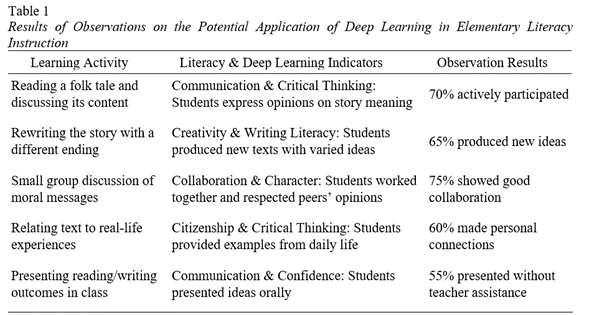
Reading and writing literacy is a fundamental skill that forms the foundation of both cognitive and social development for elementary school students. However, literacy instruction in many schools remains largely conventional, emphasizing rote memorization and technical drills, with limited opportunities to cultivate critical thinking, creativity, and collaboration. This study aims to examine the transformation of literacy instruction through the implementation of a deep learning approach in elementary schools. The research employed a descriptive design combining simple quantitative methods with qualitative observation. The participants were Grade 2 students in an elementary school, with a control group receiving conventional instruction and an experimental group engaged in deep learning–based instruction. Data were collected through literacy tests (fluency, comprehension, spelling, and writing structure), classroom observations, and teacher interviews. The results indicate significant improvements in the experimental group compared to the control, with an average literacy gain of 15%, particularly in reading comprehension (18%) and reading fluency (15%). Observations further revealed increased student participation in discussions, greater confidence in expressing ideas, and enhanced creativity in story writing. These findings suggest that deep learning not only strengthens technical literacy skills but also fosters adaptive, meaningful, and 21st-century–aligned learning experiences. The study concludes that the application of deep learning holds transformative potential for literacy instruction in elementary schools. Nevertheless, its scope remains limited to a small-scale, short-term implementation, highlighting the need for broader and more longitudinal studies to examine the sustainability of its impact.References
Akbaba, A., & Senkal, O. (2024). Educational technologies and elementary level education: A bibliometric analysis. Heliyon, 10(4), e24476. https://doi.org/10.1016/j.heliyon.2024.e24476
Almazroa, H., & Alotaibi, W. (2023). Teaching 21st Century Skills: Understanding the Depth and Width of the Challenges to Shape Proactive Teacher Education Programmes. Sustainability, 15(9). https://doi.org/10.3390/su15097365
Anderson, R. C., & Spiro, R. J. (2021). Literacy in the 21st century: Bridging cognitive and sociocultural views. Journal of Literacy Research, 53(2), 137–156. https://doi.org/10.1177/1086296X211013418
Fullan, M. (2021). The right drivers for whole system success. Melbourne: Centre for Strategic Education.
Fullan, M., & Langworthy, M. (2014). A rich seam: How new pedagogies find deep learning. London: Pearson.
Fullan, M., Quinn, J., & McEachen, J. (2018). Deep learning: Engage the world change the world. Thousand Oaks, CA: Corwin Press.
Kucirkova, N. (2020). Children’s reading with digital books: Past moving quickly to the future. Child Development Perspectives, 14(4), 201–207. https://doi.org/10.1111/cdep.12392
Murnane, R. J., Sawhill, I., & Snow, C. E. (2012). Literacy challenges for the twenty-first century. The Future of Children, 22(2), 3–15. https://doi.org/10.1353/foc.2012.0010
NPDL (New Pedagogies for Deep Learning). (2023). New Pedagogies for Deep Learning Getting Started Guide 2023.
Ng, D. T. K., Lee, M., Tan, R. J. Y., Hu, X., Downie, J. S., & Chu, S. K. W. (2023). A review of AI teaching and learning from 2000 to 2020. Education and Information Technologies, 28, 8445–8501. https://doi.org/10.1007/s10639-022-11491-w
UNESCO. (2021). Reimagining our futures together: A new social contract for education. Paris: UNESCO Publishing.
Toquero, S. C., & Capistrano, F. M. (2024). Pedagogy in the 21st Century Literature Classroom: Teachers’ teaching mechanisms, challenges, and coping mechanisms. International Journal of Research Studies in Education, 13(6). https://doi.org/10.5861/ijrse.2024.24046
Voogt, J., & Roblin, N. P. (2012). A comparative analysis of international frameworks for 21st century competences: Implications for national curriculum policies. Journal of Curriculum Studies, 44(3), 299–321. https://doi.org/10.1080/00220272.2012.668938
Downloads
Published
How to Cite
Conference Proceedings Volume
Section
License
Copyright (c) 2025 Duhita Savira Wardani, Ryan Dwi Puspita, Deden Herdiana Altaftazani

This work is licensed under a Creative Commons Attribution-ShareAlike 4.0 International License.