From Evidence to Practice: A Mixed-Method Study of Deep Learning and Nature-Based Learning for Fostering Creativity in Early Childhood
Keywords:
early childhood creativity, deep learning, nature-based Learning, mixed-method, needs analysisAbstract
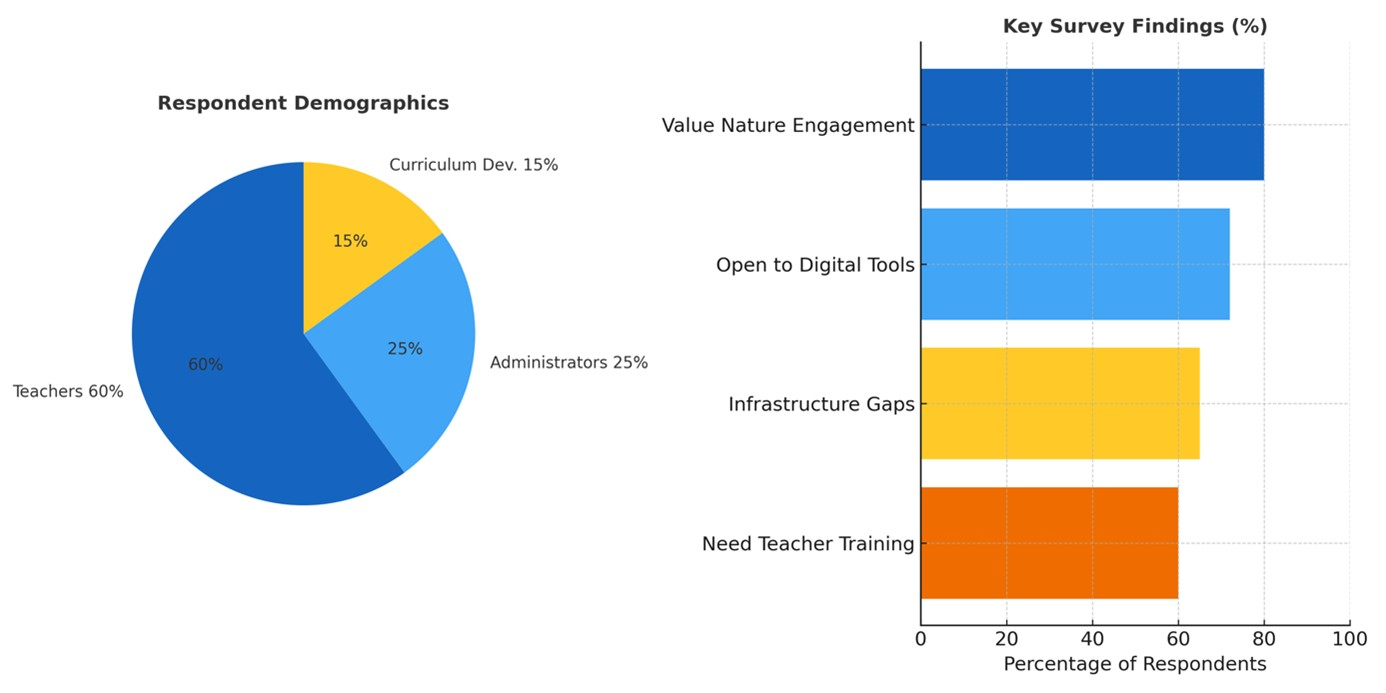
Creativity is a foundational competency in early childhood education, yet teacher-centered routines and assessment-driven practices often curtail children’s authentic exploration. This paper examines how deep-learning strategies can be integrated with nature-based learning to foster creativity in developmentally appropriate ways. We adopted a mixed-method design: a Systematic Literature Review (2014–2024) that identified 41 eligible studies, and a needs analysis with 45 stakeholders (teachers, school leaders, curriculum developers) using surveys and follow-up interviews. The review shows that nature-based pedagogies reliably support divergent thinking, problem-solving, and socio-emotional well-being through multisensory, open-ended activities, whereas current deep-learning applications in early childhood are concentrated on personalization and assessment rather than creativity. Field data indicate strong practitioner openness to hybrid approaches—conditional on teacher mediation, minimal screen time, privacy-by-design, and feasibility under infrastructure constraints. Synthesizing both strands, we propose a nature-first, tech-light framework: outdoor provocations as the creative engine; AI used for low-intrusion documentation, pattern-spotting, and reflective prompts; offline-first delivery; and assessment that privileges portfolios and observational rubrics over narrow screen-based proxies. The study advances the field by translating scattered evidence into implementable design requirements and by offering a context-sensitive pathway for scaling creativity-oriented hybrid pedagogy in early childhood settings.
References
Bærentsen, K. B., & Trettvik, J. (2021). Designing Hybrid Learning Environments: Combining Digital Tools and Nature-Based Experiences. In Proceedings of the 15th International Conference on Interaction Design and Children (pp. 55–65). ACM.
Bento, G., & Dias, G. (2017). The importance of outdoor play for young children’s healthy development. Porto Biomedical Journal, 2(5), 157–160. https://doi.org/10.1016/j.pbj.2017.03.003
Bento, G., & Dias, G. (2017). The importance of outdoor play for young children’s healthy development. Porto Biomedical Journal, 2(5), 157–160. https://doi.org/10.1016/j.pbj.2017.03.003
Braun, V., & Clarke, V. (2006). Using thematic analysis in psychology. Qualitative Research in Psychology, 3(2), 77–101. https://doi.org/10.1191/1478088706qp063o
Chen, L., Chen, P., & Lin, Z. (2020). Artificial intelligence in education: A review. IEEE Access, 8, 75264–75278. https://doi.org/10.1109/ACCESS.2020.2988510
Craft, A. (2019). Creativity and education futures: Learning in a digital age (2nd ed.). Trentham Books.Gull, C., Leven, T., & Sager, S. (2019). Outdoor play and nature-based learning in early childhood education. Journal of Adventure Education and Outdoor Learning, 19(3), 227–241. https://doi.org/10.1080/14729679.2018.1507831
Edwards, C., Gandini, L., & Forman, G. (2012). The Hundred Languages of Children: The Reggio Emilia Experience in Transformation (3rd ed.). Praeger.
Gardner, H. (2009). Multiple Intelligences: New Horizons. Basic Books.
Gull, C., Leven, T., & Sager, S. (2019). Outdoor play and nature-based learning in early childhood education. Journal of Adventure Education and Outdoor Learning, 19(3), 227–241. https://doi.org/10.1080/14729679.2018.1507831
Halimah, L. (2020). Teachers’ Perspectives on Blended Learning in Early Childhood Education: Challenges and Opportunities. In Proceedings of the 5th International Conference on Education and Technology (ICET). Atlantis Press.
Holmes, W., Bialik, M., & Fadel, C. (2019). Artificial intelligence in education: Promises and implications for teaching and learning. Center for Curriculum Redesign.
Jeffrey, B., & Craft, A. (2019). Creative teaching and teaching for creativity: Distinctions and relationships. Educational Studies, 45(1), 77–88.
Johnstone, A., Martin, A., Cordovil, R., Fjørtoft, I., Iivonen, S., Jidovtseff, B., … Wells, V. (2022). Nature-Based Early Childhood Education and Children’s Social, Emotional and Cognitive Development: A Mixed-Methods Systematic Review. International Journal of Environmental Research and Public Health, 19(10), 5967. https://doi.org/10.3390/ijerph19105967
Kuo, M., Barnes, M., & Jordan, C. (2019). Do experiences with nature promote learning? Converging evidence of a cause-and-effect relationship. Frontiers in Psychology, 10, 305. https://doi.org/10.3389/fpsyg.2019.00305
Luckin, R. (2018). Machine learning and human intelligence: The future of education for the 21st century. UCL IOE Press.
Malaguzzi, L. (1998). History, ideas, and basic philosophy: An interview with Lella Gandini. In C. Edwards, L. Gandini, & G. Forman (Eds.), The hundred languages of children: The Reggio Emilia approach—Advanced reflections (2nd ed., pp. 49–97). Ablex Publishing.
Miles, M. B., Huberman, A. M., & Saldaña, J. (2014). Qualitative data analysis: A methods sourcebook (3rd ed.). SAGE Publications.
OECD. (2021). AI in Education: Promises and Challenges. OECD Publishing.
Page, M. J., McKenzie, J. E., Bossuyt, P. M., Boutron, I., Hoffmann, T. C., Mulrow, C. D., ... & Moher, D. (2021). The PRISMA 2020 statement: An updated guideline for reporting systematic reviews. BMJ, 372, n71. https://doi.org/10.1136/bmj.n71
Parette, H. P., Quesenberry, A. C., & Blum, C. (2010). Missing the boat with technology usage in early childhood settings: A 21st-century view of developmentally appropriate practice. Early Childhood Education Journal, 37(5), 335–343. https://doi.org/10.1007/s10643-009-0352-x
Piaget, J. (1952). The origins of intelligence in children. International Universities Press.
Robinson, K. (2020). Out of our minds: The power of being creative (3rd ed.). Capstone.
Setyaningsih, D., Handasah, R. R., Mamma, A. T., Krobo, A., Olua, E., & Iryouw, V. (2024). Fostering Eco-literacy and Naturalistic Intelligence through Environmentally Based Education in Coastal Preschool. In Proceedings of the International Conference on Early Childhood Education (ICECE). Jakarta: UNJ.
Sobel, D. (2004). Place-based education: Connecting classrooms and communities. Orion Society.
Solichah, N., & Shofiah, N. (2023). AI Literacy in Early Childhood Education: A Scoping Review. Psikologika: Jurnal Pemikiran dan Penelitian Psikologi, 29(2), 105–122. https://doi.org/10.20885/psikologika.vol29.iss2.art1
Torrance, E. P. (2018). The nature of creativity. Cambridge University Press.
Vygotsky, L. S. (1978). Mind in society: The development of higher psychological processes. Harvard University Press.
Wells, N. M., & Lekies, K. S. (2021). Nature and the life course: Pathways from childhood nature experiences to adult environmentalism. Children, Youth and Environments, 31(1), 96–118. https://doi.org/10.7721/chilyoutenvi.31.1.0096
Wilson, R. A. (2018). Nature and young children: Encouraging creative play and learning in natural environments (3rd ed.). Routledge.
Wilson, R. A. (2018). Nature and young children: Encouraging creative play and learning in natural environments (3rd ed.). Routledge.
Zawacki-Richter, O., Marín, V. I., Bond, M., & Gouverneur, F. (2019). Systematic review of research on artificial intelligence applications in higher education–where are the educators? International Journal of Educational Technology in Higher Education, 16(1), 39. https://doi.org/10.1186/s41239-019-0171-0
Downloads
Published
How to Cite
Conference Proceedings Volume
Section
License
Copyright (c) 2025 Ayu Riagandi, Erie Siti Syarah

This work is licensed under a Creative Commons Attribution-ShareAlike 4.0 International License.