Exploring Needs for Folktale-Integrated English Materials: Enhancing Oral Proficiency, Learner Independence, and Cultural Understanding
Keywords:
cultural-based pedagogy, learner-centered Materials, oral communication skills, independent learning strategies, intercultural competenceAbstract
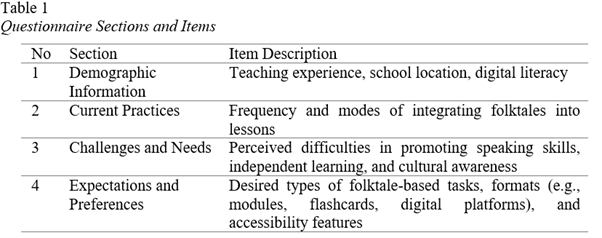
The integration of local folktales into English language teaching is a culturally responsive approach that supports language skills while fostering learners’ identity and intercultural awareness. Developing such materials, however, requires a clear understanding of teacher and learner needs to ensure relevance and effectiveness. This study explores the specific needs of junior high school teachers and students in designing folktale-based English learning materials that promote speaking proficiency, learner autonomy, and cultural awareness. Using a qualitative case study within a research and development (R&D) framework, the study applied the 3D model (Define, Design, Develop), adapted from Thiagarajan, Semmel, and Semmel’s Four-D model. Data were collected through questionnaires, document analysis (curriculum, syllabus, lesson plans, and existing teaching materials), and fieldwork involving English teachers, who are also postgraduate students at Universitas Terbuka, and junior high school learners from schools across western, central, and eastern Indonesia. Descriptive statistics and content analysis were used to examine preferences, challenges, and expectations regarding folktale-based materials. Findings indicate three major needs: (1) interactive and accessible materials to strengthen speaking practice, (2) tasks that foster autonomy through reflective and collaborative learning, and (3) integration of cultural elements that connect local identity with global perspectives. These insights inform the development of prototypes such as folktale-based modules and flashcards that are both contextually relevant and pedagogically sound. The study contributes empirical evidence to English language education by demonstrating how needs analysis can guide the creation of culturally grounded materials that integrate language skills, learner autonomy, and cultural awareness.References
Akbari, R. (2023). Local culture and global competence in EFL material design. ELT Journal, 77(2), 221–233.
Alsubaie, M., & Ashuraidah, A. (2021). Storytelling as a tool for developing oral fluency in EFL classrooms. Asian EFL Journal, 28(1), 45–62.
Benson, P. (2020). Learner autonomy and language education: Renewing the research agenda. Language Teaching, 53(1), 1–13.
Benson, P. (2021). Teaching and researching autonomy in language learning. Routledge.
Chang, H. (2023). The role of culture in language education: Folktales and intercultural competence. Language and Education, 37(1), 77-92.
Chang, M. (2022). Integrating indigenous stories in English education: A pathway to intercultural competence. Language, Culture and Curriculum, 35(3), 302–317.
Chen, W., & Tseng, Y. (2023). Accessibility and equity in EFL material design: Insights from rural schools. TESOL Quarterly, 57(1), 101–122.
Chung, K., & Kim, H. (2022). Integrating cultural materials in language teaching. TESOL Journal, 14(2), 145-162.
Damayanti, I. (2021). Autonomy in Indonesian EFL classrooms: Teacher perspectives and challenges. Indonesian Journal of Applied Linguistics, 11(2), 285–297.
Fitriani, F., & Yusuf, Y. (2020). The effect of storytelling on students’ speaking ability in EFL classrooms. Studies in English Language and Education, 7(1), 44–58.
Foley, J. (2021). Enhancing intercultural communication through folktales. Journal of Intercultural Communication, 45(3), 123-138.
Graham, D. (2023). Using storytelling to enhance speaking skills in language learning. Language Teaching Research, 27(4), 501-517.
Harris, J. (2022). Cultural-based pedagogy in English language teaching. Journal of Educational Research, 58(1), 35-48.
Huang, L. (2023). Peer feedback and collaborative learning in EFL storytelling projects. System, 115, 102978.
Kramsch, C. (2020). Language and culture in language teaching. Language Teaching, 53(2), 179–192.
Kuswanto, M., & Nugroho, H. (2022). Needs analysis in curriculum design for English language teaching. Journal of Language and Education, 56(2), 233-249.
Lengkanawati, N. (2021). Students’ autonomy in EFL learning: Teachers’ perspectives and practices. TESOL International Journal, 16(5), 65–82.
Marini, A., & Sari, D. (2021). Folklore in ELT: Building cultural identity through English learning. Journal of English Language Teaching and Linguistics, 6(2), 315–330.
Miller, S., & Lin, T. (2020). Implementing cultural materials in language instruction: Challenges and opportunities. Journal of Language Teaching and Research, 14(3), 189-201.
Ming, X., & Zhang, W. (2021). Designing culturally relevant language learning tasks. Modern Language Journal, 105(5), 672-689.
Nguyen, H. (2022). Collaborative autonomy in Vietnamese EFL classrooms: Teachers’ roles and practices. RELC Journal, 53(4), 667–684.
Rahman, M., & Anwar, S. (2022). Reflective practices in EFL classrooms: Impacts on learner autonomy. Innovation in Language Learning and Teaching, 16(5), 389–402.
Sari, M., & Wahyuni, R. (2022). Digital divide and material accessibility in Indonesian schools. Indonesian Journal of English Education, 9(1), 89–105.
Setyowati, L., & Sukmawan, S. (2021). Folklore-based ELT materials: Strengthening local wisdom in English classrooms. Journal of ELT Research, 6(1), 1–12.
Sánchez, V., & Walker, M. (2021). The role of cultural identity in language education. Linguistics and Education, 57(2), 65-78.
Sweeney, C., & Roberts, J. (2022). Differentiated instruction with folktale-based materials. Language Learning Journal, 51(2), 148-162.
Tan, A., & Smith, R. (2022). Folktales and intercultural competence in language education. Language and Culture, 19(4), 291-304.
Widodo, H. P. (2019). Bringing local culture to EFL classrooms: The use of folktales in Indonesia. Asian EFL Journal, 23(3), 181–200.
Widodo, H. P., & Perfecto, M. (2022). Culturally sustaining pedagogy in ELT material development. ELT Journal, 76(4), 451–461.
Yates, S., & Jiang, X. (2020). The impact of folktales on speaking proficiency. Journal of Language and Literature Education, 42(3), 193-210.
Yusof, N., & Saad, N. (2021). Enhancing speaking proficiency through guided storytelling. Pertanika Journal of Social Sciences & Humanities, 29(3), 1547–1562.
Downloads
Published
How to Cite
Conference Proceedings Volume
Section
License
Copyright (c) 2025 Widya Rizky Pratiwi, Juhana Juhana, Bachtiar Bachtiar

This work is licensed under a Creative Commons Attribution-ShareAlike 4.0 International License.